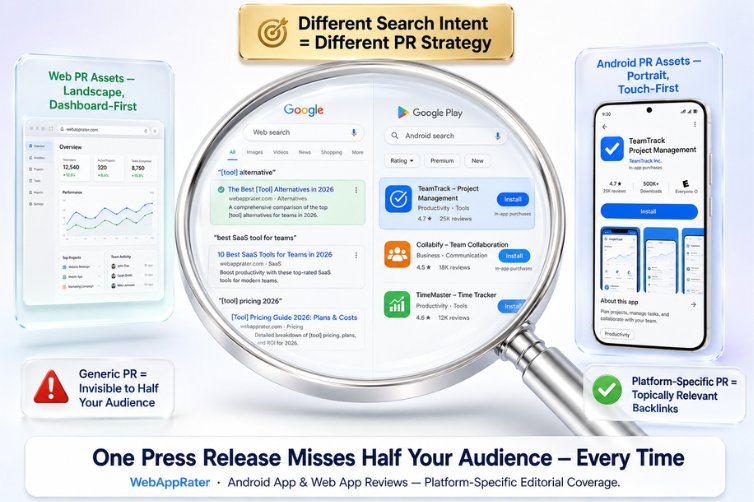
A lot of developers build for both. A SaaS product with a web dashboard and an Android companion app. A productivity tool that runs in the browser and on the phone. A service that starts on desktop and expands to mobile.
When launch day arrives, most of them write one press release and send it everywhere.
That is the mistake.
A web app launch and an Android app launch are different news events, aimed at different audiences, distributed through different channels, and optimised for completely different search behaviour. Treating them as a single announcement means both versions underperform – the web launch misses the depth that SaaS press expects, and the Android launch misses the platform-specific coverage that actually moves Play Store metrics. Understanding Android app launch PR versus web app PR is one of the most practical decisions a developer can make before their first outreach email goes out.
Here is how to think about every dimension of that difference – and what to do when you are launching both at the same time.
1. The Audience Is Different
Web app users are discovered through Product Hunt, Hacker News, SaaS-focused newsletters, and B2B technology blogs. They are evaluating tools for workflow improvement, third-party integrations, team collaboration, and subscription pricing. The journalists and writers who cover them work in startup media, productivity publishing, and tech generalist outlets. Their readers are founders, product managers, and knowledge workers making deliberate software decisions.
Android app users are discovered through a completely separate ecosystem. The Play Store algorithm, Android-focused editorial sites, app discovery communities, and mobile tech YouTube channels are where they find new apps. They are evaluating applications for daily use on a device they carry everywhere – often making download decisions in under 30 seconds based on screenshots and review snippets. The press that covers them is Android blogs, mobile tech publications, app review platforms, and Google-ecosystem content creators.
These two audiences do not overlap in the way most developers assume. A developer who sends their press release only to SaaS and startup media will receive zero coverage in the places Android users actually read – and zero Play Store traffic from editorial discovery. The audiences are distinct, and the press that reaches each of them is equally distinct.
WebAppRater covers both sides of this divide. Our Android app reviews and our web application reviews serve demonstrably different readerships – and the apps that perform best in each category are the ones whose developers understood which audience they were talking to before they wrote their first headline.
2. The Search Intent Is Different
Search behaviour differs sharply between web app users and Android app users – and this difference directly determines what kind of press coverage earns you organic traffic versus what kind earns you nothing useful.
When someone searches for your web app, they are typically typing queries like:
- “[tool name] alternative”
- “best [category] tool for teams”
- “[tool name] pricing”
- “[tool name] vs [competitor]”
- “[tool name] review 2026”
When someone searches for your Android app, they are typing:
- “best [category] app for Android”
- “[app name] Android”
- “[app name] APK”
- “[category] app free Android 2026”
- “[app name] review Play Store”
These are different keyword sets, different SERP landscapes, and different content types that rank for them. Web app PR earns you coverage that ranks for the first set. Android-specific PR earns you coverage that ranks for the second. If you only produce one type of coverage, you are invisible to half your potential audience in organic search – permanently, unless you go back and run the missing track.
This is not a minor gap. It is the difference between a launch that drives sustained organic discovery for months after publication and one that generates a brief traffic spike and fades. Running both PR tracks from the beginning is always more efficient than retrofitting the missing one six months later.
3. The Platform Context Is Different
Web apps live in a browser. Android apps live inside an ecosystem – the Play Store, with its own search algorithm, its own ratings infrastructure, its own editorial featuring process, and its own set of external signals that influence discoverability in ways that differ meaningfully from how web SEO works.
Press coverage for an Android app does something that press coverage for a web tool does not: it feeds the Play Store’s external signal layer. When multiple indexed Android publications link to your Play Store listing, Google’s app algorithm registers that external interest as a signal of relevance and credibility. Reviews on Android-focused platforms generate keyword-rich anchor text pointing at your listing. That combination – external editorial links from topically relevant Android domains plus platform-native ratings and reviews – is a documented contributor to Play Store search ranking improvement.
A generic tech press release distributed through a startup platform like Product Hunt or mentioned in a SaaS newsletter does not accomplish this. The links come from off-topic domains with no topical relationship to Android development. They carry minimal SEO weight for Play Store purposes and generate no editorial discovery within the Android content ecosystem.
An Android-specific PR approach – distributing through platforms that Android press and editorial sites actually read – creates the topically relevant backlink profile that supports Play Store discoverability alongside organic search. This is why the distribution channel matters as much as the content of the press release itself.
4. The Distribution Channel Is Different
For web apps, Product Hunt is a legitimate and often high-impact launch channel. For Android apps, it is largely irrelevant – the audience there is not the audience downloading Android apps from the Play Store, and the links it generates carry no particular weight in the Android content ecosystem.
Android app PR belongs on platforms that are read by Android users, linked to by Android publications, and indexed within the Android content graph. That means dedicated Android news sites, Android app review platforms, mobile tech YouTube channels, and Android-focused press distribution services.
Submitting your Android launch to an Android-focused press wire rather than a generic startup announcement platform means your release lands in front of the journalists, bloggers, and editorial aggregators that specifically cover the Play Store ecosystem. For maximum visibility, using a dedicated App Launch Service ensures your release is packaged and distributed specifically for Android-focused media channels. The backlinks you earn are topically relevant – from Android-domain publications to your Android app’s Play Store listing – which carries measurably more SEO weight than an off-topic mention on a general technology site.
This is not an argument against launching on Product Hunt or general tech press if you have a web layer. Do both. But give your Android app its own distribution moment on its own platform, timed separately, with its own assets and its own messaging. They are different products serving different contexts, and they deserve different PR strategies reflecting that.
5. The Assets Are Different
Web app screenshots are desktop-first by necessity – wide browser windows, feature-rich dashboards, complex navigation structures, keyboard-centric workflows. They are designed to demonstrate depth, integration capability, and professional utility. A SaaS press editor expects to see these and knows how to write about them.
Android app screenshots are vertical, touch-first, and built to communicate core value in a single glance on a 6-inch screen. Play Store users scroll fast. Press editors covering Android apps need portrait-orientation assets that show the mobile experience specifically – not a cropped version of the desktop dashboard adapted for a phone screenshot slot.
When you write Android PR, you need Android-native assets prepared separately from your web assets:
- Portrait screenshots at 1080×1920 or similar – showing real mobile UI in actual use contexts, not mockups or concept frames
- A feature graphic at 1920×1080 for press use, distinct from the Play Store feature graphic format (1024×500) – both need to exist
- A short screen recording of the mobile gesture flow – showing how the app actually feels to use on a touchscreen, not a demonstration of the web dashboard scrolling on a phone browser
- App icon at 1024×1024 PNG with transparent background – this appears in every Android editorial article that covers your launch and needs to work at small sizes on varied backgrounds
Sending a press outlet your desktop screenshots for an Android app story is one of the most common practical mistakes in dual-platform launches. It signals immediately to the editor that mobile is a secondary consideration in your product development – and the coverage, if it comes at all, reflects that assessment. When you submit to WebAppRater, include the right asset format for the right platform and you will reach the right editorial context for each.
How to Handle a Dual Launch Correctly
If you are launching both a web app and an Android app simultaneously – or adding Android to an existing web product – the correct approach is to structure your PR in two entirely separate tracks, run in parallel but treated as independent campaigns:
Track 1 – Web and SaaS launch: Product Hunt, Hacker News Show HN, SaaS newsletters, startup press, B2B technology blogs. Messaging centres on workflow value, integration with existing tools, pricing and plan structure, and team collaboration use cases. Screenshots are desktop-first. The press release emphasises what the tool does for a professional using a computer.
Track 2 – Android launch: Android press platforms, mobile technology blogs, app review sites like WebAppRater, Android subreddits, Google Play editorial consideration submission. Messaging centres on the mobile experience specifically – offline capability, device integration, gesture-first interaction, on-the-go use cases that the web version cannot serve. Screenshots are portrait-orientation mobile UI. The press release emphasises what the app does for a person using their phone.
Write two separate press releases. Use different headlines. Use different opening paragraphs. Emphasise different features in each – the ones that are most relevant to that platform’s users, not the complete feature list that applies to both. The web version discusses the dashboard, the integrations, the team workspace. The Android version discusses the app, the offline mode, the notification system, the home screen widget.
Same product. Different story told for a different audience through a different distribution channel. Both tracks earn you coverage you could not get from running either one alone.
The One Question to Ask Before You Finalise Your PR Strategy
Before you write your press release – either one – ask this: where does my target user spend time when they are not using my app?
If the answer is “reading startup newsletters and following SaaS Twitter,” your web PR belongs in those channels with that audience’s language and that format’s expectations.
If the answer is “on their Android phone, reading app reviews, watching mobile tech YouTube, and scrolling Reddit’s r/AndroidApps,” your Android PR belongs in the Android content ecosystem – written for that audience, formatted for those platforms, distributed through the channels they actually read.
A press release is not just an announcement. It is a targeting decision. The developer who treats it that way – writing twice, distributing twice, using the right assets for each platform – gets twice the coverage from the same launch event. That coverage compounds. The web links support web SEO. The Android links support Play Store discoverability. Neither track substitutes for the other, and neither one works as well without the one running beside it.
Frequently Asked Questions
Does every Android app really need its own separate press release from the web app version?
Yes – if you want coverage in Android-specific publications and Play Store discoverability benefits from topically relevant backlinks. A single press release written for a general tech audience will not be picked up by Android editorial platforms that cover the Play Store ecosystem specifically, because it is not written for their audience or formatted for their editorial style. The additional effort of writing a second, Android-specific release is consistently returned in coverage volume and coverage quality from the Android press ecosystem.
What is the most important asset difference between web app PR and Android app PR?
Screenshot orientation. Web app press materials are desktop-first – wide, landscape-format interface screenshots showing feature depth. Android app press materials need to be portrait-orientation mobile screenshots showing the actual phone UI. Press editors covering Android apps need to illustrate their articles with screenshots that look native to the platform they are writing about. Desktop screenshots in an Android app review immediately undermine the editorial credibility of the piece and reduce the likelihood of publication.
Is Product Hunt worth using for an Android app launch?
Marginally, if your Android app also has a meaningful web layer that Product Hunt’s audience cares about. For Android-only apps or apps where the mobile experience is the primary product, Product Hunt’s audience is the wrong target – it skews heavily toward web product evaluators and SaaS buyers, not Android users making Play Store download decisions. The links it generates carry no particular weight in the Android content ecosystem. Use it for your web layer if it applies. Use dedicated Android press distribution for the Android launch.
How do the backlinks from Android press coverage affect Play Store ranking?
External links from topically relevant Android-domain publications pointing at your Play Store listing are a recognised external signal in Google’s app ranking algorithm. The key word is “topically relevant” – links from Android news sites, Android app review platforms, and mobile tech publications carry significantly more weight for Play Store purposes than links from general technology or startup media. Running Android-specific PR that earns coverage on Android-domain sites generates exactly the right type of external signal profile. Generic tech press coverage generates off-topic links that provide minimal Play Store benefit regardless of the domain authority of the linking site.
How do I submit my app to WebAppRater for review?
Use our app submission page. We review web applications, SaaS tools, Android apps, and iOS apps across all categories. Submit the correct asset format for your platform – portrait mobile screenshots for Android submissions, desktop UI screenshots for web app submissions – and include your press release link and Play Store or web URL. Apps submitted with complete, platform-appropriate assets move through our review queue faster than those that require us to request additional materials.
WebAppRater covers web applications, SaaS tools, Android apps, and iOS apps. Submit your app for editorial review consideration via our submission page.