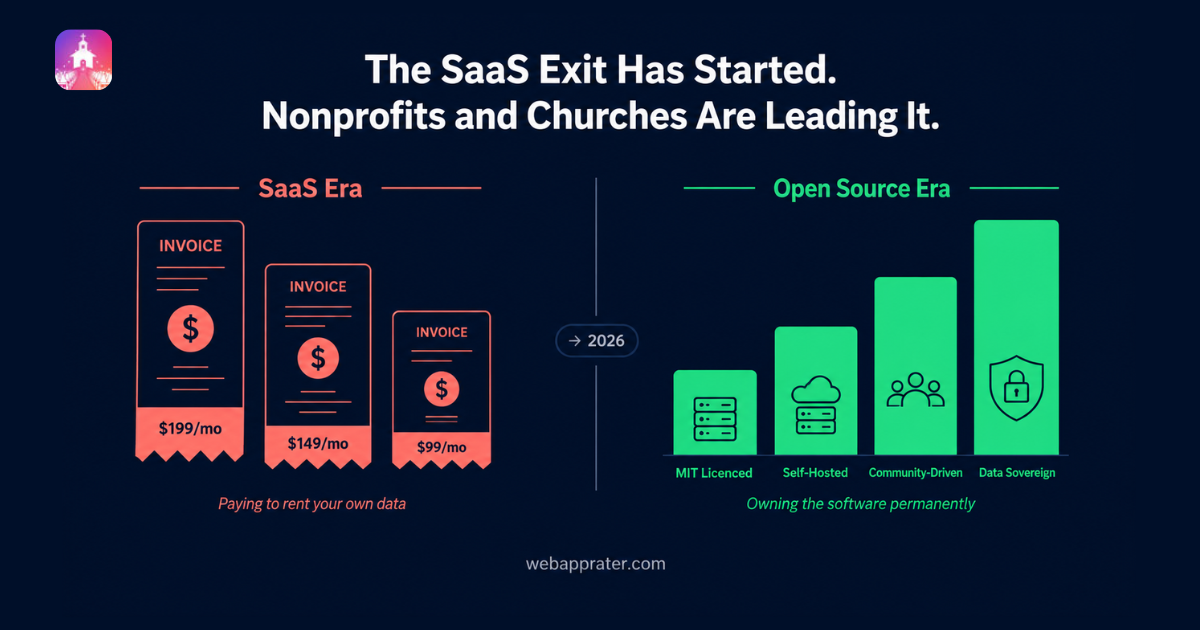
Something quiet has been happening in the nonprofit software market over the last few years. Organisations that once dutifully paid monthly subscription fees for cloud-based management tools have started asking a different question: why are we paying to rent access to our own data?
It is a question that leads, fairly quickly, to open source software.
For commercial businesses, the SaaS model makes straightforward sense – pay as you go, no infrastructure overhead, scale up or down as needed. But nonprofits, religious organisations, and community groups operate under fundamentally different constraints. Their budgets are limited and often dependent on donations or grants. Their data is sensitive in ways that commercial customer data is not. Their relationship with technology is frequently mediated by volunteers rather than IT professionals. The SaaS model was not designed with any of these characteristics in mind.
Open source church management software is one of the clearest examples of where this shift is already visible and measurable – and understanding why it is happening in the church sector illuminates a broader pattern playing out across the nonprofit technology landscape.
The SaaS Pricing Problem for Nonprofits
The nonprofit software market is dominated by platforms that price for the median commercial customer – which is not the median nonprofit organisation.
A church management system charging $99 per month is pricing for a congregation of several hundred people with a full-time administrator, a reliable monthly giving income, and a technology budget. For the majority of the world’s congregations – smaller, operating in developing markets, with volunteer-run administration and thin budgets – that pricing is not “affordable with some prioritisation.” It is simply out of reach.
The same dynamic applies across the nonprofit sector. Donor management platforms. Volunteer scheduling tools. Event management systems. Community membership databases. Each one individually priced at a level that assumes a financial base that most nonprofits do not have. Annual software subscription costs across these categories can easily reach $5,000 to $15,000 for a mid-sized organisation – costs that represent meaningful percentages of operating budgets that should be going toward the mission.
The result is a familiar patchwork of workarounds: spreadsheets, free-tier tools with significant functional limitations, manual processes that absorb volunteer time, and an administrative overhead that compounds year over year. What makes this particularly frustrating is that the underlying software – the database logic, the communication tools, the reporting dashboards – is not technically complex to build or host. The recurring cost is in the licence, not the infrastructure. And a licence cost that exists primarily to fund a software vendor’s growth ambitions is a cost that open source eliminates entirely.
What Open Source Actually Means in Practice
The term “open source” gets used loosely enough that it is worth being specific about what it actually means for a nonprofit organisation evaluating platforms.
Open source software is software whose source code is publicly available – typically on a hosting platform like GitHub – and licensed for use, modification, and distribution without restriction. The most permissive mainstream licence is the MIT licence, which allows any organisation to use the software for any purpose, modify it to suit their specific requirements, and deploy it on their own infrastructure without paying the original developer anything, now or in the future.
The practical implications for a nonprofit or religious organisation are substantial:
No monthly licence fee. The software itself is free to use indefinitely. Costs are limited to hosting infrastructure – typically a VPS or shared hosting account costing a few dollars per month.
Data sovereignty. The organisation’s data lives on its own server. It is not held in a third-party cloud, subject to the terms of service of a vendor the organisation has no meaningful control over. If the vendor shuts down, gets acquired, or materially changes its pricing – none of that affects an organisation running its own instance of the software.
No vendor lock-in. Paid platforms have a structural incentive to make data migration difficult and switching costs high. Open source platforms have no such incentive – the data format is transparent, the codebase is publicly readable, and moving to a different system is a tractable technical exercise rather than a hostage negotiation.
Community-driven development. When multiple organisations use and contribute to an open source platform, improvements made by one user become available to all. This creates a development dynamic that is qualitatively different from the closed cycle of a commercial SaaS product where feature priorities are determined by enterprise sales pipelines.
The trade-off is genuine and worth stating clearly: open source software typically requires more technical involvement to set up than a hosted SaaS product. The organisation needs either internal technical capacity or a willingness to engage a developer for installation and configuration. For many nonprofits, this is a one-time cost rather than a recurring one – and it is frequently far less than one year’s worth of equivalent SaaS subscription fees.
It is also worth noting the scale at which open source has proven itself in adjacent markets. WordPress, an MIT-style GPL-licenced open source platform, currently powers approximately 43% of all websites globally according to W3Techs – a market share built entirely on free software that any organisation can download, deploy, and modify without a licence fee. The maturity of the open source model is not in question. The question is whether nonprofit-specific platforms have reached a comparable level of completeness and usability – and in several categories, they demonstrably have.
The Nonprofit Sector’s Relationship With Open Source
Open source adoption in the commercial software world is well-documented and extensive. Linux powers the overwhelming majority of the world’s web servers. PostgreSQL and MySQL underpin databases across industries. Frameworks like Laravel, React, and Django are the foundations of countless production applications used by millions of people daily. According to the GitHub Octoverse report, open source contribution and adoption continues to expand across every region and sector of the global software economy.
But the nonprofit sector has been slower to follow this pattern, and the reasons are instructive.
Part of the lag is cultural. Nonprofit technology decisions are frequently made by people whose primary expertise is ministry, community development, or programme delivery – not software evaluation. The phrase “open source” can carry associations with technical complexity, lack of formal support, and risk that deter adoption even when the underlying platforms have matured significantly beyond those associations.
Part of it is also the support question, which is legitimate. When something fails with a SaaS platform, there is a vendor to call and a service level agreement to reference. With self-hosted open source software, support typically comes from community forums, documentation, or – if the organisation is paying for managed hosting – a service provider. For organisations without technical staff, this feels like meaningful risk.
What is changing this calculation is the emergence of managed open source services – organisations that take a free, open source platform, host it on professional infrastructure, keep it maintained and updated, and provide support, for a monthly fee that is a fraction of the cost of a comparable commercial SaaS subscription. The software remains open source. The data remains under the organisation’s control. The operational overhead is handled externally. This model is particularly relevant for churches, schools, and NGOs where administrative budgets are thin, data sensitivity is high, and technical staff are absent.
Church Management: The Clearest Case Study
The church management software sector illustrates the open source shift particularly clearly, because the gap between what churches globally need and what commercial platforms cost has historically been acute.
Church management software needs to handle member directories, giving and financial records, attendance tracking, event management, communication tools, and increasingly a mobile application for congregation members. The commercial platforms that serve this need well – Planning Center, Breeze, ChurchTrac, and others – are capable, well-maintained products that charge accordingly. Monthly fees range from $50 to $300 depending on congregation size and feature set. Annual costs routinely exceed $1,000 for a mid-sized congregation. Over five years, a single platform subscription represents $5,000 to $15,000 in software licensing costs.
For churches in Western markets with stable giving income, these costs are manageable budget line items. For the growing majority of the world’s congregations – in Nigeria, Kenya, Brazil, the Philippines, India, and Indonesia, where church growth is most active – they are not manageable. They are simply prohibitive.
Open source church management platforms have emerged specifically to address this gap. ChurchCMS is one active example – a full-featured open source church management platform built on Laravel and Vue.js, MIT licensed, with a companion Android app included at no additional cost. It covers the complete range of church administration functions: member directory, online giving with regional payment gateway support (including M-Pesa, Flutterwave, and Paystack for African markets), QR code attendance tracking, event management, live broadcasting, a built-in church website CMS, and a branded mobile app.
What is particularly notable about its adoption pattern is that ChurchCMS is currently deployed by congregations in more than fourteen countries – many of which the development team did not explicitly market to. Developers in those regions discovered the repository on GitHub, assessed it as fit for purpose, and deployed it for local churches. This organic distribution pattern – open source software adopted in markets the original developers had not planned for – is a recurring characteristic of genuinely permissive licensing in practice. You cannot control where MIT-licensed software travels, which means distribution scales in ways that a commercial product with regional pricing restrictions cannot replicate.
Other Nonprofit Sectors Following the Same Pattern
Churches are the most visible case study in this shift, but they are not the only nonprofit category where the pattern is visible.
Schools and educational institutions in developing markets are adopting open source student information and administration systems for structurally identical reasons. The commercial alternatives – purpose-built school management software with subscription pricing – are calibrated for Western private school budgets, not for community schools in rural India, East Africa, or Southeast Asia. Open source school ERP platforms serve these institutions at infrastructure cost rather than licensing cost.
NGOs and humanitarian organisations have been among the earlier adopters of open source CRM and beneficiary management tools, partly from cost considerations and partly because international development funding increasingly comes with data sovereignty requirements that make third-party cloud platforms legally or contractually complicated. When a donor requires that beneficiary data be stored within a specific jurisdiction, self-hosted open source is often the only architecturally clean answer.
Community organisations and housing associations are increasingly evaluating open source alternatives to commercial member management tools, particularly in markets where GDPR and data residency regulations add compliance complexity to cloud-based solutions. Self-hosted open source removes the data residency question entirely – the data is where the organisation puts it.
The common thread across all of these sectors is structural rather than incidental. The organisations most in need of good administration software are frequently the ones least able to afford commercial alternatives. Open source addresses this not as a compromise or a lesser option, but as the architecturally correct solution for organisations that need to own their data, control their costs, and operate independently of vendor decisions they have no influence over.
The Managed Hosting Middle Ground
For nonprofit organisations that want the benefits of open source software without taking on the technical overhead of self-hosting, the managed open source hosting model is worth understanding as a distinct option.
In this model, a service provider installs and maintains an open source platform on professional infrastructure – handling server updates, backups, security patches, and first-line support – and charges a monthly fee for that operational service. The key distinctions from a traditional SaaS subscription are meaningful:
The underlying software remains open source. If the organisation ever decides to move to self-hosting, switch providers, or migrate to a different platform, it can export its data and take it wherever it chooses. There is no lock-in to the service provider’s proprietary system, because there is no proprietary system.
The fee is for infrastructure and operational service, not for software licensing. This typically makes managed open source hosting significantly cheaper than a comparable commercial SaaS subscription for the same functional capability.
The data remains under the organisation’s control under the terms of the hosting agreement, with explicit data portability rights – rather than under a vendor’s standard terms of service that may include data use provisions the organisation has not carefully read.
For many nonprofit organisations, this managed hosting model represents the practical optimum – lower total cost than commercial SaaS, lower technical burden than pure self-hosting, and genuine data ownership with demonstrated portability. It is the option that makes open source accessible to the organisations that need it most but have the least internal technical capacity.
Where the Market Is Heading
The trajectory for open source in the nonprofit and religious organisation sector points clearly in one direction. As platforms mature, documentation improves, the developer communities around them grow, and managed hosting services for specific platforms proliferate, the friction of adopting open source tools decreases. The cost advantage over commercial SaaS, meanwhile, compounds over time – every month a nonprofit is not paying a $99 or $199 subscription fee is a month where that resource goes toward the mission rather than toward software licensing.
For organisations that made the transition to open source administration tools three to five years ago, the cumulative savings are already significant and the operational disruption of switching is behind them. For those making the decision now, the platforms available in 2026 are more complete, more actively maintained, and better documented than they have ever been. The maturity gap between commercial and open source options in the nonprofit sector has narrowed substantially.
The SaaS model will continue to serve organisations for whom convenience, bundled support, and predictable monthly costs outweigh data ownership and long-term expense considerations. There are legitimate use cases where that trade-off makes sense. But for nonprofits, churches, NGOs, and community organisations operating on constrained budgets in data-sensitive environments, open source church management software and the broader category of open source nonprofit tools have moved from a technical curiosity reserved for developer-heavy organisations to a genuinely compelling operational default.
The organisations that understand this earliest are the ones whose mission budgets will thank them for it in year three and year five.
Frequently Asked Questions
What is the difference between open source church management software and a standard SaaS platform?
The fundamental difference is ownership. A SaaS platform charges a recurring licence fee and stores your congregation’s data on the vendor’s infrastructure under the vendor’s terms of service. An open source church management platform is software you download, install on your own server, and run permanently – your data stays on your infrastructure, the software licence costs nothing, and no external vendor can change the terms under which you access your own system. The trade-off is that setup requires either internal technical capacity or a one-time engagement with a developer, rather than a sign-up form.
Is open source church software stable enough for production use by a real congregation?
Yes – and the answer has been yes for several years. The leading open source church management platforms are built on production-grade frameworks (Laravel, Vue.js, PostgreSQL) that power enterprise applications used by millions of people globally. They are actively maintained, carry public changelogs, and have user communities of congregations running them in production. The question of stability is more accurately framed as: does the specific platform you are evaluating have active maintenance and a clear development roadmap? For mature open source church platforms, the answer is yes.
How does MIT licence software work for a church that has no developers?
The MIT licence gives anyone the legal right to use, modify, and run the software – but it does not require anyone to use it directly. A church with no developers can engage a developer or a managed hosting service provider to install and configure the platform on their behalf. The church pays for the service, not the software. The managed hosting model – where a provider handles installation, maintenance, and support for a monthly fee substantially below equivalent SaaS pricing – makes MIT-licensed platforms accessible to organisations with no technical staff. The software remains free; the service is what has a cost.
What data sovereignty advantages does self-hosted open source software provide?
When a church or nonprofit self-hosts its management software, member data, giving records, and pastoral notes never leave infrastructure the organisation controls. This is directly relevant to GDPR compliance in Europe, data protection requirements in various national jurisdictions, and the increasingly common organisational policy of not storing sensitive member information in third-party cloud systems. With a SaaS platform, you are accepting the vendor’s data handling terms and trusting their security practices. With self-hosted software, you are the data controller in every meaningful sense – technically and legally.
Which types of nonprofit organisations benefit most from open source software in 2026?
The organisations that benefit most are those where three conditions overlap: budget constraints that make commercial SaaS pricing meaningful rather than marginal, data sensitivity that makes vendor-controlled cloud storage a genuine concern, and operational contexts where the software needs to work without a monthly payment – because mission continuity should not depend on subscription renewal. This description applies most directly to churches and religious organisations in developing markets, NGOs with donor-imposed data sovereignty requirements, schools in low-resource contexts, and community organisations operating under GDPR or equivalent data regulations. The managed hosting model extends these benefits to organisations within that group that also lack internal technical capacity.
WebAppRater covers the app and software landscape across business, productivity, and community tools. This article is part of our ongoing coverage of emerging trends in nonprofit and community software. Submit your web application or software product for review via our submission page.