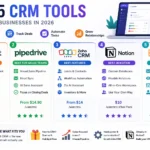
A CRM – Customer Relationship Management tool – is the single highest-leverage software investment most small businesses make in 2026. Without one, client information lives across email threads, spreadsheets, sticky notes, and individual team members’ memories, creating a fragile system that breaks down whenever a team member is unavailable. With the right CRM, client conversations, deal stages, follow-up tasks, and relationship history are visible to the entire team in one place. These five web app CRMs were tested across real small business scenarios over sixty days.
HubSpot CRM – Best Free CRM with Room to Grow
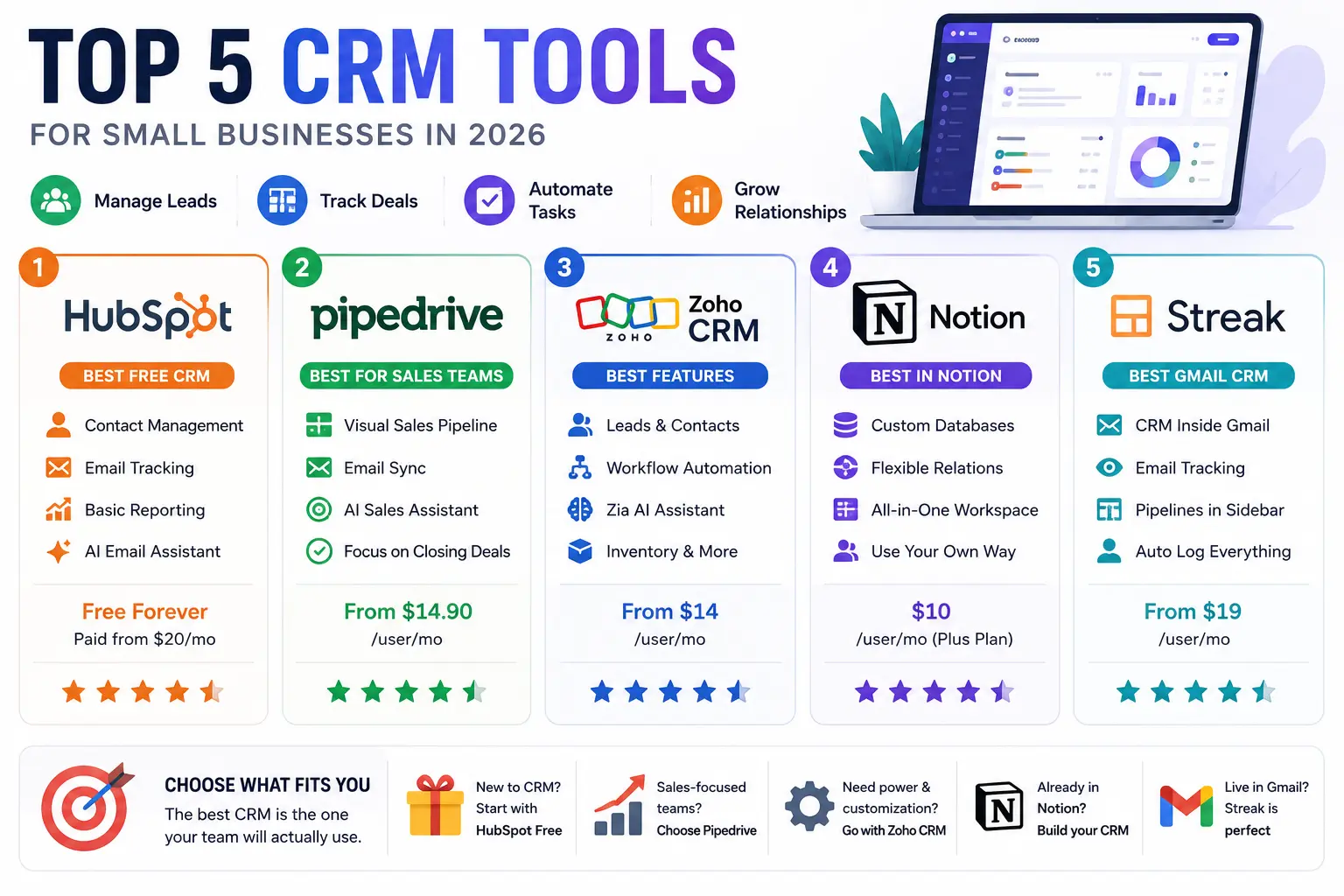
HubSpot’s free CRM is the most generous free offering in the CRM category, covering contact management, deal pipeline, email tracking, and basic reporting for unlimited users without any time limit or user cap. For small businesses that are new to CRM and want to evaluate the category without committing budget, HubSpot free provides a fully functional starting point that can grow into HubSpot’s paid products as needs evolve.
The 2026 AI features in HubSpot include email drafting assistance in the compose window, meeting summarisation linked to contact records, and predictive lead scoring that ranks contacts by likelihood to convert based on their engagement patterns. These features are available at different plan tiers but the core relationship management functionality at zero cost makes HubSpot the default recommendation for budget-constrained small businesses.
Start free at www.hubspot.com. Paid plans from twenty dollars per month when you need advanced marketing automation, custom reporting, or sales sequences.
Pipedrive – Best for Sales-Focused Teams
Pipedrive is built around the sales pipeline as the primary interface rather than treating it as one view among many. Every feature in Pipedrive is designed to help sales teams move deals forward – the visual pipeline shows exactly where each deal is, what the next action is, and how long it has been in the current stage. The AI Sales Assistant in 2026 analyses deal patterns and suggests specific actions most likely to advance stalled deals based on historical data.
The email integration in Pipedrive is the most practical in this comparison – two-way sync with Gmail or Outlook means every email sent or received by any team member is automatically logged against the relevant contact record without manual entry. For sales teams whose primary communication is email, this automatic logging removes the discipline requirement that makes manual CRM data entry inconsistent.
Visit www.pipedrive.com. Plans start at fourteen dollars and ninety cents per user per month.
Zoho CRM – Best Feature Density at Mid-Range Price
Zoho CRM provides the most comprehensive feature set of any CRM in its price range, including lead and contact management, deal pipelines, workflow automation, AI-powered predictions, inventory management for product-based businesses, and territory management for sales teams with geographic assignments. The breadth of features makes it initially overwhelming but rewards investment in setup with a deeply customised sales and relationship management system.
The Zia AI assistant in Zoho CRM 2026 provides conversational access to CRM data – ask Zia for the contacts you have not touched in thirty days, the deals most likely to close this month, or the average deal size by source, and receive immediate answers without navigating to specific reports. For sales managers monitoring team performance, conversational access to pipeline data is significantly faster than traditional report navigation.
Visit www.zoho.com/crm. Free plan for three users. Paid plans from fourteen dollars per user per month.
Notion as a CRM – Best for Teams Already in Notion
For teams who already use Notion as their primary workspace, building a CRM using Notion’s database and relation features is a viable and cost-effective approach that keeps all client information within the same environment as project documentation, meeting notes, and team wikis. The flexibility to define exactly the fields, views, and relationships that match your specific sales process is Notion’s advantage over purpose-built CRMs.
Community CRM templates provide starting points for teams who want a tested data structure without building from scratch. The limitation compared to purpose-built CRMs is the absence of native email logging, deal probability calculations, and the AI-powered insights that tools like Pipedrive and Zoho provide. Notion CRM works best for teams with relatively simple sales processes and fewer than fifty active client relationships.
Visit www.notion.so. The Plus plan at ten dollars per user per month provides the database and relation features needed for an effective CRM implementation.
Streak – Best Gmail-Native CRM
Streak lives entirely inside Gmail, turning your inbox into a CRM without requiring any context switching to a separate application. Deals are tracked as pipelines directly in the Gmail sidebar, email tracking shows when contacts open your messages, and contact records aggregate all email history automatically since everything flows through Gmail.
For small business owners and consultants who live in Gmail and resist adopting separate tools, Streak removes the CRM adoption barrier almost entirely. The trade-off is that the CRM is only as accessible as Gmail – mobile access works through the Gmail app but lacks the dedicated mobile CRM experience of purpose-built alternatives.
Visit www.streak.com. Free plan for individuals with basic pipeline features. Paid plans from nineteen dollars per user per month.
How to Choose the Right CRM for Your Small Business
The right CRM is the one your team will actually use consistently rather than the one with the most features. Start with HubSpot free to understand how CRM workflows apply to your business before investing in a paid plan. If your primary need is visual sales pipeline management with automatic email logging, Pipedrive is the best purpose-built option. If you need deep customisation and broad functionality at a competitive price, Zoho CRM delivers the most for the investment. If you already live in Gmail, Streak removes all adoption friction. If your team is already in Notion and your CRM needs are simple, build there first.