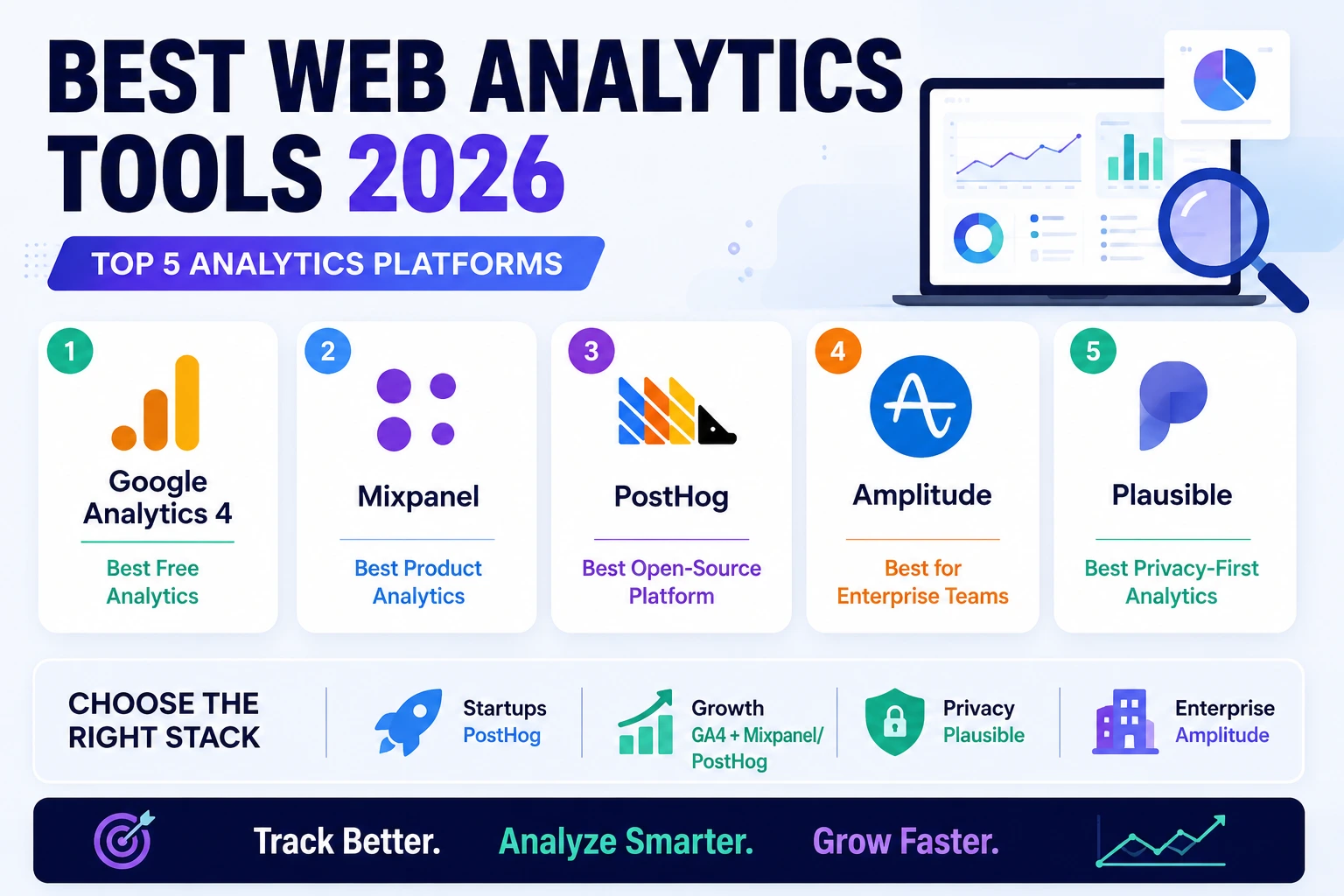
Analytics tools are only as valuable as the decisions they inform. The best analytics platform for your web app is not necessarily the one with the most features or the biggest brand name – it is the one your team will actually use consistently, that makes your most important metrics immediately visible, and that provides the depth of analysis needed to answer the questions that determine product direction. These five tools cover every budget and team size from solo founders to enterprise product teams.
Google Analytics 4 – Best Free Analytics Foundation
GA4 is the universal starting point for web analytics in 2026. The event-based data model replaced the session-based model of Universal Analytics, which gives product teams more flexibility in defining what constitutes a meaningful interaction without being constrained by predefined session and pageview concepts.
The integration with Google Ads, Google Search Console, and the broader Google marketing ecosystem makes GA4 particularly valuable for teams running paid acquisition campaigns alongside their organic content – the attribution across these channels is significantly more reliable when all data flows through a single Google property.
The limitations of GA4 become apparent for product analytics use cases – understanding user behaviour within an authenticated application, tracking multi-step conversion funnels for complex onboarding flows, or analysing the cohort retention that determines whether a subscription product is healthy. For these use cases, a dedicated product analytics tool alongside GA4 is the right architecture.
Access GA4 at analytics.google.com. Completely free with no meaningful usage limits for most products.
Mixpanel – Best Product Analytics for User Behaviour
Mixpanel is the most widely adopted dedicated product analytics platform in 2026, used by product teams at companies ranging from Series A startups to publicly listed technology companies. The core strength is the depth and flexibility of user behaviour analysis – cohort analysis showing how specific user segments retain over time, funnel analysis with multi-step conversion breakdowns, and A/B testing infrastructure integrated directly with the analytics layer.
The Mixpanel query interface is intuitive enough for non-technical product managers and designers to build their own analyses without engineering support, which dramatically accelerates the feedback loop between product decisions and data validation. The 2026 AI-powered analysis features can automatically identify the user segments with the highest and lowest retention rates and suggest potential explanations based on the behaviour signals in the data.
Visit www.mixpanel.com. Free tier for up to one million monthly events, which covers most early-stage products. Paid plans from twenty-eight dollars per month.
PostHog – Best Open-Source Analytics with Full Control
PostHog is the most important addition to the analytics landscape in recent years and its 2026 version is the most complete open-source product analytics platform available. Session recording, feature flags, A/B testing, funnel analysis, retention cohorts, heatmaps, and event-based analytics are all included in a single platform with a generous free tier and the option to self-host your entire data pipeline if data sovereignty or privacy requirements demand it.
For startups and indie developers who want Mixpanel-level analytics depth without the Mixpanel pricing at scale, PostHog’s free tier – covering one million events per month and full access to all features – is genuinely extraordinary value. The self-hosting option specifically is unique among major analytics platforms and makes PostHog the only reasonable choice for applications in industries where sending user data to a third-party analytics provider creates legal or compliance complexity.
Visit www.posthog.com. Free tier includes one million events monthly with full feature access. Source code available on github.com/PostHog/posthog.
Amplitude – Best for Enterprise Product Teams
Amplitude is the enterprise standard for product analytics in 2026, used by product organisations at major technology companies where the sophistication of analysis and the scale of data volume exceed what Mixpanel or PostHog can handle efficiently. The Compass feature automatically identifies leading indicators of retention from your event data, which surfaces non-obvious product improvements that are difficult to find through manual analysis.
Amplitude’s predictive analytics capabilities in 2026 allow forecasting future retention, revenue, and conversion based on historical patterns – a feature that moves analytics from descriptive to genuinely predictive for product decisions. The price reflects the enterprise positioning, with meaningful costs at the scale these teams typically operate.
Visit www.amplitude.com. Free starter plan available. Paid plans for growth and enterprise teams.
Plausible – Best Privacy-First Simple Analytics
Plausible is the best option for teams who need basic traffic analytics – pageviews, traffic sources, and basic conversion tracking – without the complexity of GA4 or the cost of dedicated product analytics platforms, and specifically want a privacy-first approach that does not collect personal data or require cookie consent banners.
The Plausible interface loads in seconds and shows essential metrics in a single clean dashboard without the configuration overhead that makes GA4 inaccessible to non-technical users. For content sites, marketing pages, and early-stage products where basic traffic understanding is sufficient, Plausible is the most elegant and ethical solution available.
Visit www.plausible.io. Starts at nine dollars per month for up to ten thousand monthly pageviews.
Which Analytics Stack Should Your Web App Use
- Early-stage product with limited budget: PostHog free tier covers everything you need including session recording and feature flags
- Growth-stage product with paid acquisition: GA4 for marketing attribution plus PostHog or Mixpanel for product analytics
- Content or marketing site that prioritises privacy: Plausible for clean, simple, cookie-free analytics
- Enterprise product organisation with large engineering team: Amplitude for the depth of analysis and predictive capabilities
- Any product requiring full data control or in regulated industries: PostHog self-hosted with your own infrastructure
The Analytics Trap to Avoid in 2026
The biggest analytics mistake teams make in 2026 is installing a comprehensive analytics platform and then never committing to a weekly ritual of actually reviewing the data and acting on it. Analytics tools create value only when they inform decisions. Pick the simplest tool that answers your current most important questions, establish a weekly data review habit, and upgrade your analytics infrastructure only when you have exhausted what simpler tools can tell you