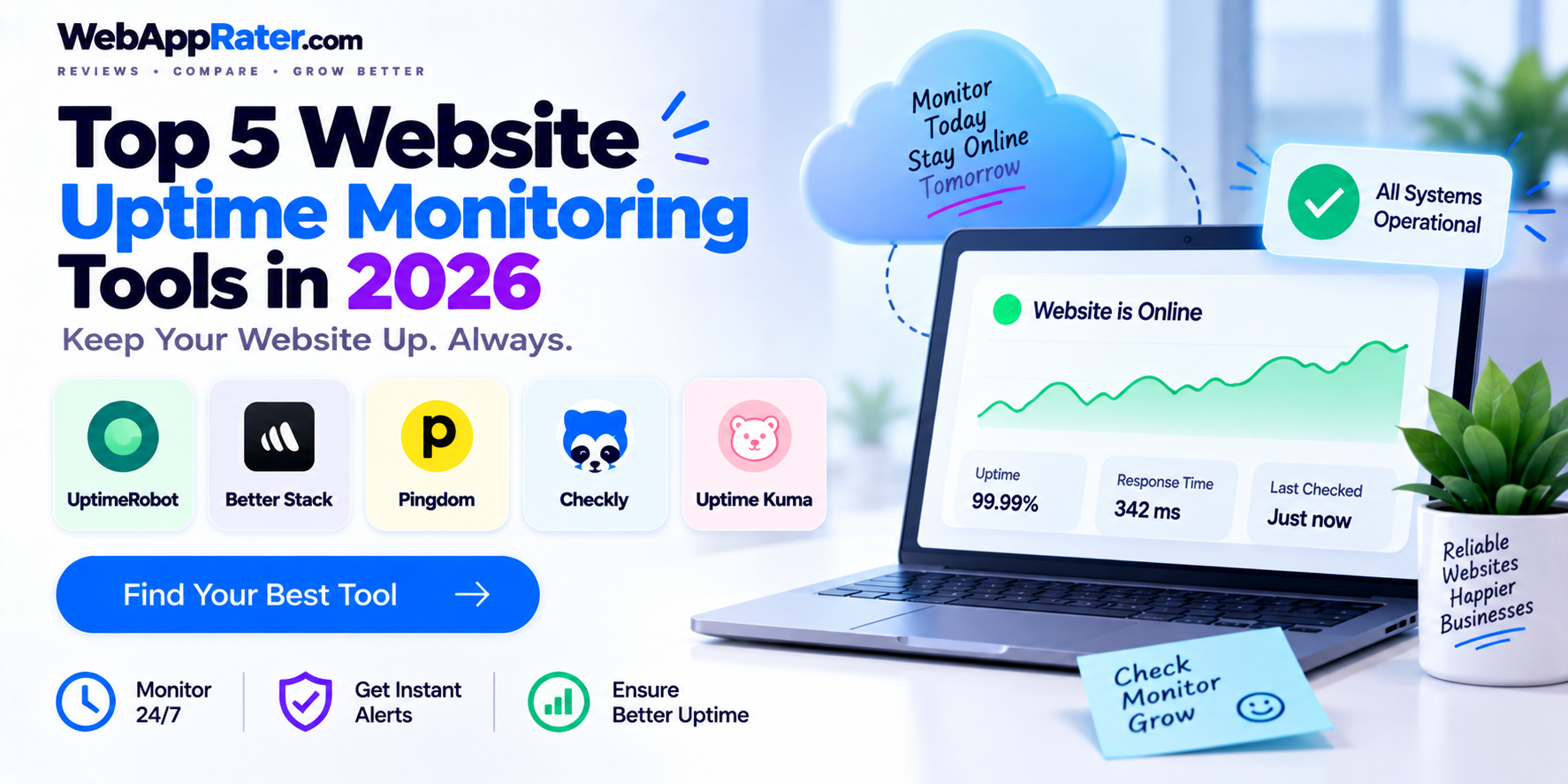
Uptime monitoring solves a genuinely simple but critical problem: checking on a scheduled interval whether a website, API, or service is actually reachable, then alerting the right people the moment it isn’t. The stakes are real, with Gartner estimating the average cost of IT downtime at $5,600 per minute, meaning even 15 minutes of undetected API downtime can mean lost customers and real reputational damage. The category has split into distinct tiers worth understanding, generous free checkers, all-in-one incident management platforms, and full observability suites, since the right tool depends heavily on whether uptime needs to stand alone or plug into a broader workflow. Here are five platforms worth knowing in 2026.
UptimeRobot
UptimeRobot remains the most widely adopted starting point in the category, built its enormous user base of more than 3.4 million users on a single, generous offer: 50 monitors free, forever, checked every 5 minutes with basic status pages and three months of data retention. Its free tier’s earlier non-commercial-use restriction has since been removed, making it genuinely usable for commercial projects without upgrading. Its PRO plan, starting around $8 for 50 monitors, adds SMS and call alerts alongside SSL certificate monitoring and background job checks, remaining one of the most budget-friendly paths to meaningfully faster, more capable monitoring.
Better Stack has positioned itself as the strongest fit specifically for teams that want uptime monitoring, incident management, and on-call scheduling unified in a single product rather than stitched together across separate tools. Its faster 30-second check intervals, considerably quicker than UptimeRobot’s free-tier 5-minute checks, meaningfully reduce detection time for critical production sites where every minute of undetected downtime carries real cost. Priced around $29 a month per seat, it targets teams whose uptime monitoring needs to share a genuine workflow with alerting and incident response rather than functioning as a standalone check-and-notify tool.
Pingdom
Pingdom combines synthetic uptime monitoring with real user monitoring and detailed page speed breakdowns, giving teams both proactive availability checks and troubleshooting insight from an actual visitor’s perspective rather than uptime data alone. Its transaction monitoring feature lets teams script genuine multi-step checks, logging in, navigating to a dashboard, verifying a specific element loads, catching functional issues that a simple HTTP status check would miss entirely. At $15 a month for just 10 uptime checks, considerably fewer than UptimeRobot’s 50 free monitors, it commands a real premium specifically for its performance breakdown and SLA reporting depth rather than pure availability checking.
Checkly
Checkly has carved out a distinct specialist niche as the monitoring-as-code platform, letting engineering teams define API and browser monitoring checks directly in version-controlled code rather than configuring them through a separate dashboard. This approach appeals specifically to teams that already treat infrastructure as code and want monitoring configuration to live alongside application code in the same CI/CD workflow, rather than existing as a disconnected, manually maintained dashboard. For engineering-led teams that want monitoring tightly integrated into existing development practices, it remains the clearest fit in the category.
Uptime Kuma rounds out a strong fifth option for teams that want to self-host monitoring entirely, giving full control over sensitive internal systems at no subscription cost, though it requires operating and maintaining the monitoring infrastructure on a team’s own server rather than relying on a managed cloud service. A common hybrid pattern worth considering: use a self-hosted tool like Uptime Kuma for internal applications behind a firewall, while relying on a managed service like UptimeRobot or Better Stack for public-facing endpoints that need alerts routed to Slack or PagerDuty. Choosing among these platforms mostly comes down to budget and workflow integration needs: UptimeRobot for the most generous free entry point, Better Stack for unified incident management, Pingdom for deep performance and transaction monitoring, and Checkly for teams that want monitoring defined as code.
Conclusion
Uptime monitoring has become close to non-negotiable infrastructure for any team running a production website or service, since the alternative, relying on users to report an outage, virtually guarantees real reputational and revenue damage before anyone on the team even notices. Whichever of these five ends up fitting a team’s budget and workflow, the underlying goal is the same: catching downtime the moment it happens rather than the moment a customer complains about it.